Practice Levels: From Isolation to Story
What the six practice levels mean and when to move up.
Every practice flow in Sound Safari asks you to pick a practice level. The six levels follow the same progression used in speech therapy — start small, then build the sound into longer and longer speech.
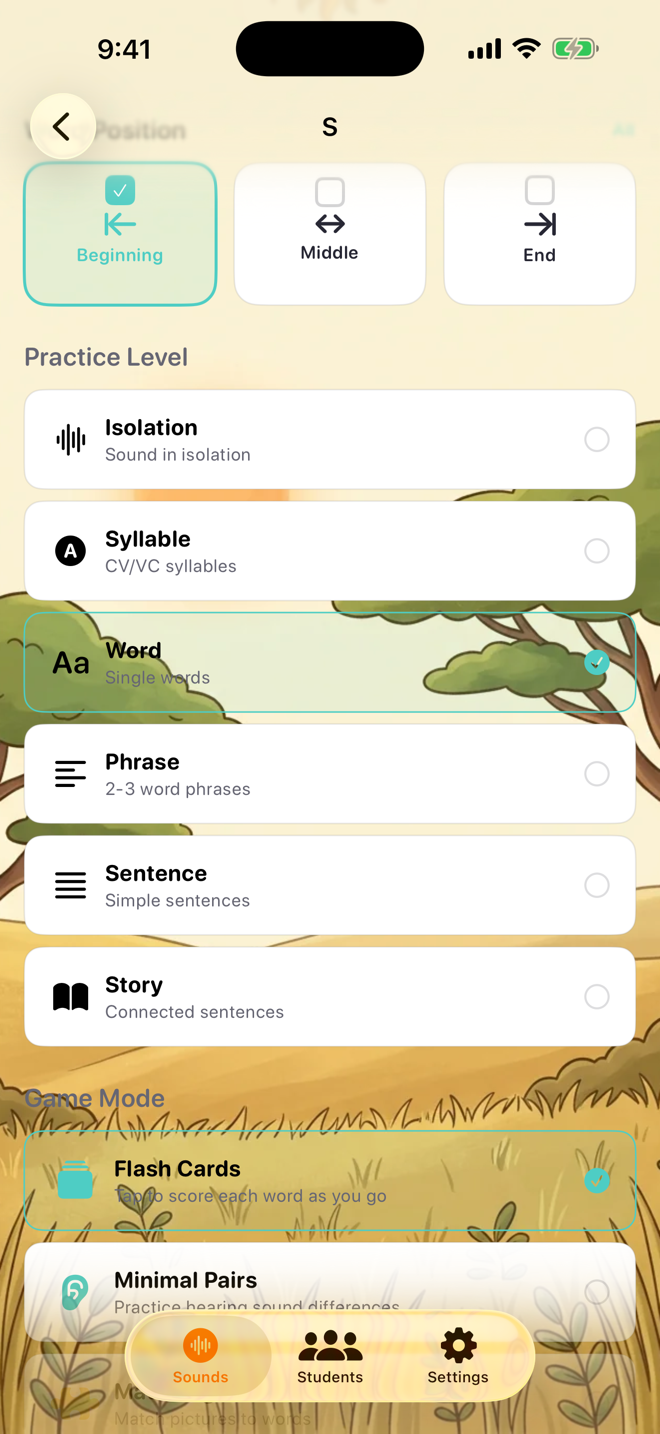
The six levels
Isolation — just the sound on its own (/s/ as "sss"). Where brand-new sounds usually start.
Syllable — the sound plus a vowel (sa, as, sas). A stepping stone between isolation and real words.
Word — single words with the sound in a chosen position. Most practice happens here.
Phrase — two-to-three word phrases.
Sentence — simple sentences.
Story — connected sentences, the closest step to natural conversation.
The position picker adapts
At Word level and above you choose a word position — Beginning, Middle, or End. At Syllable level the same section becomes Syllable Shape (CV, VC, CVC) with live example syllables for your sound, and at Isolation there's no position at all — you practice the sound by itself.

When to move up
A common rule of thumb is to move to the next level once a student is consistently accurate at the current one — many therapists use about 80% across a few sessions — and to drop back a level when accuracy falls apart. If a therapist is guiding your practice, follow their lead on when to change levels.
Was this helpful?
Still need help? Share an idea